

Every Toy has it’s Place
How to create, organize, and maintain a play therapy room is an interesting topic among therapists. There is a wide spectrum of rooms, tastes, and styles that are as variable as the therapists themselves. I’ve seen rooms that are softly nature inspired and others that are primary coloured and energizing.
From my perspective, no matter the decor, the playroom is always a sacred space. It is the safe environment where a child can express what it feels like to be them, communicate what lives beyond words, and connect with their true nature. This is a powerful, nuanced process and, for me, the room we do it in should reflect that. I hold my room with a respect and reverence similar to how I hold a child’s resilience, trauma renegotiation, or nervous system shifts. Sacred. So, I am committed to keeping our therapy space organized and predictable because I am at the altar of something truly spectacular.
I have, admittedly, been the focus of a few jokes around my practice about how particular I am about what goes where. In a recent supervision session, we opened this topic and as I clarified the reasons it is important that my room remains organized, I realized that it is actually a foundational element in my therapeutic process.
Safety and Regulation
The room’s organization supports two of my highest priorities as a therapist: the child’s felt sense of safety and my regulation in the session.
Children do not enter a therapy room as blank slates. Their bodies are already reading the space. As Allan Schore (20212) reminds us, “The right brain operates at a nonverbal level, processing the emotional and relational environment beneath conscious awareness.” Before I ever kneel down on the rug or reflect a single word, the child has taken in the lighting, the placement of the toys, the predictability of the shelves, the felt sense of order. A room that is dependable allows the child’s body to soften. A room that is chaotic can echo what they may already know too well.
Research in interpersonal neurobiology and attachment theory emphasizes that regulation is first learned through co-regulation within early caregiver relationships (Schore, 2012; Siegel, 2012; Tronick, 2007). The therapist’s nervous system becomes an influential presence in the room. My organization of the play space supports my own regulation, which in turn supports the child’s.
Order in the room helps facilitate order inside my body, which allows me to offer my regulatory capacity to little, frazzled nervous systems.
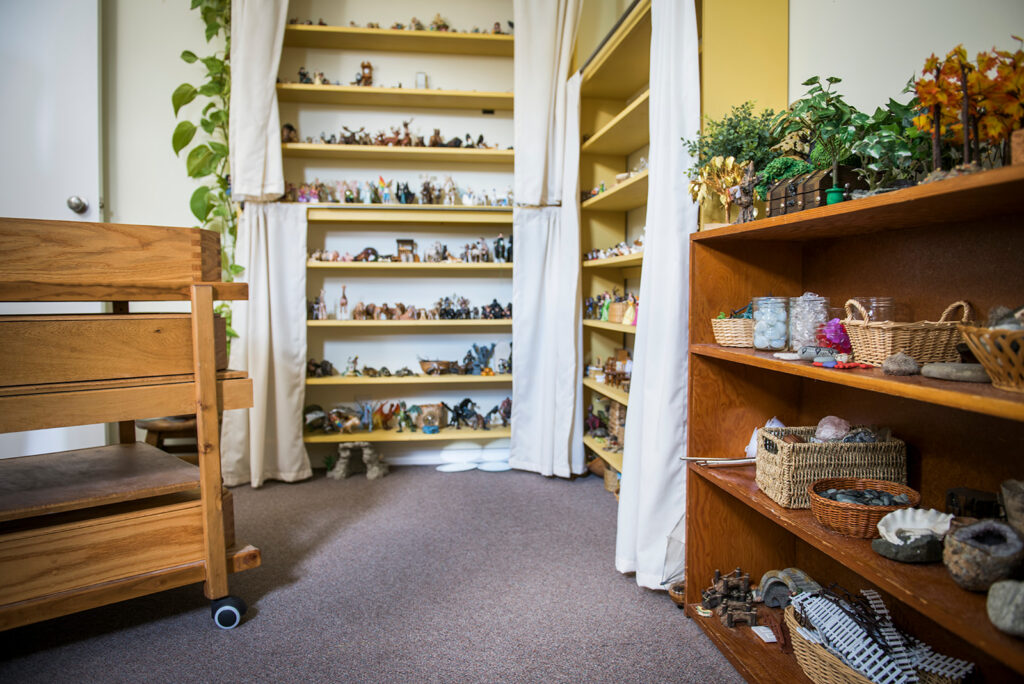
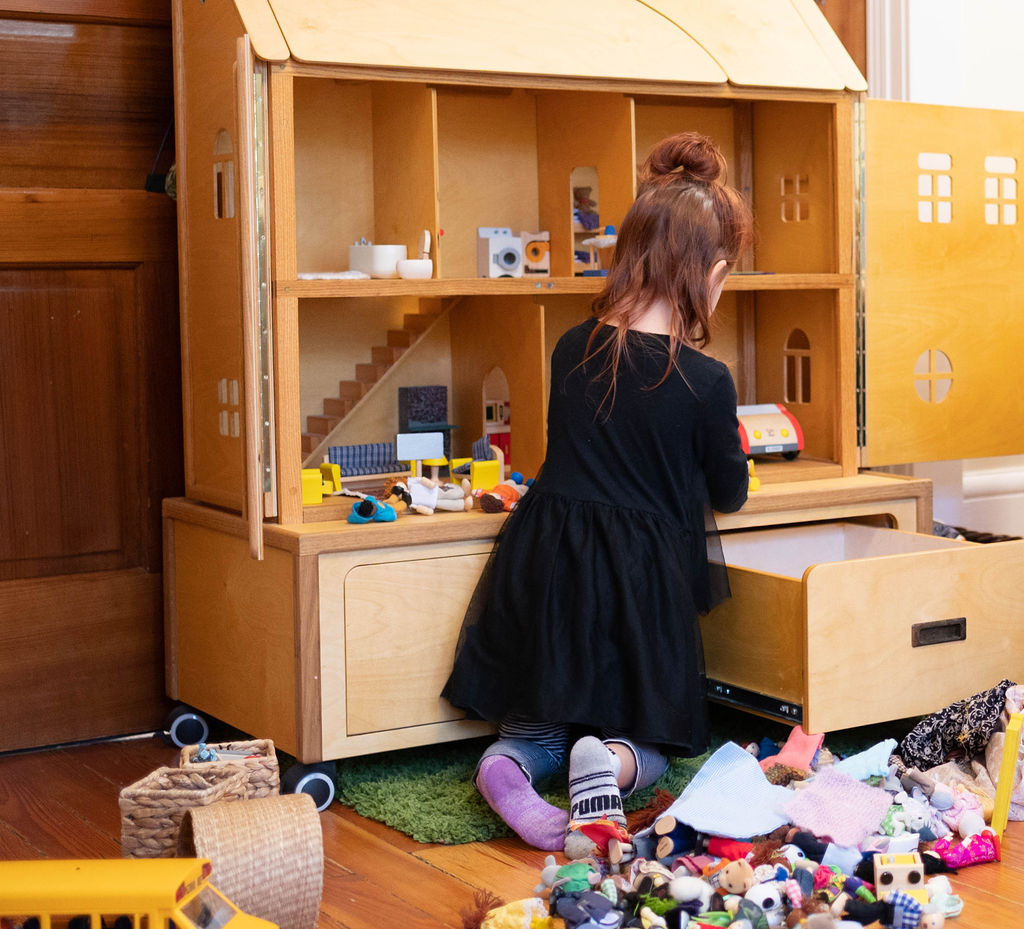
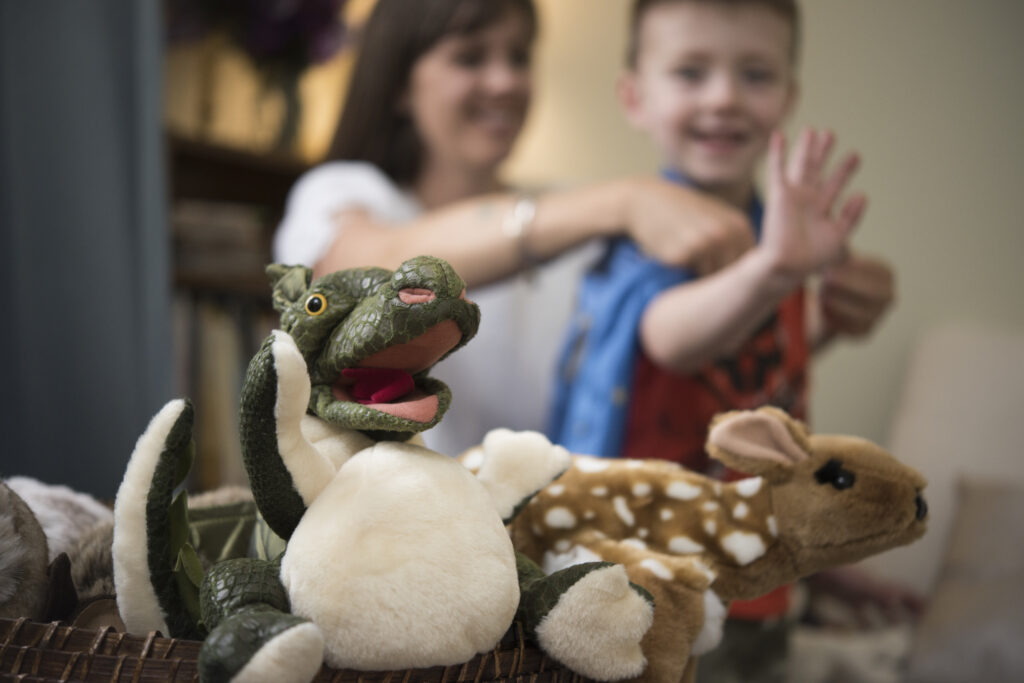
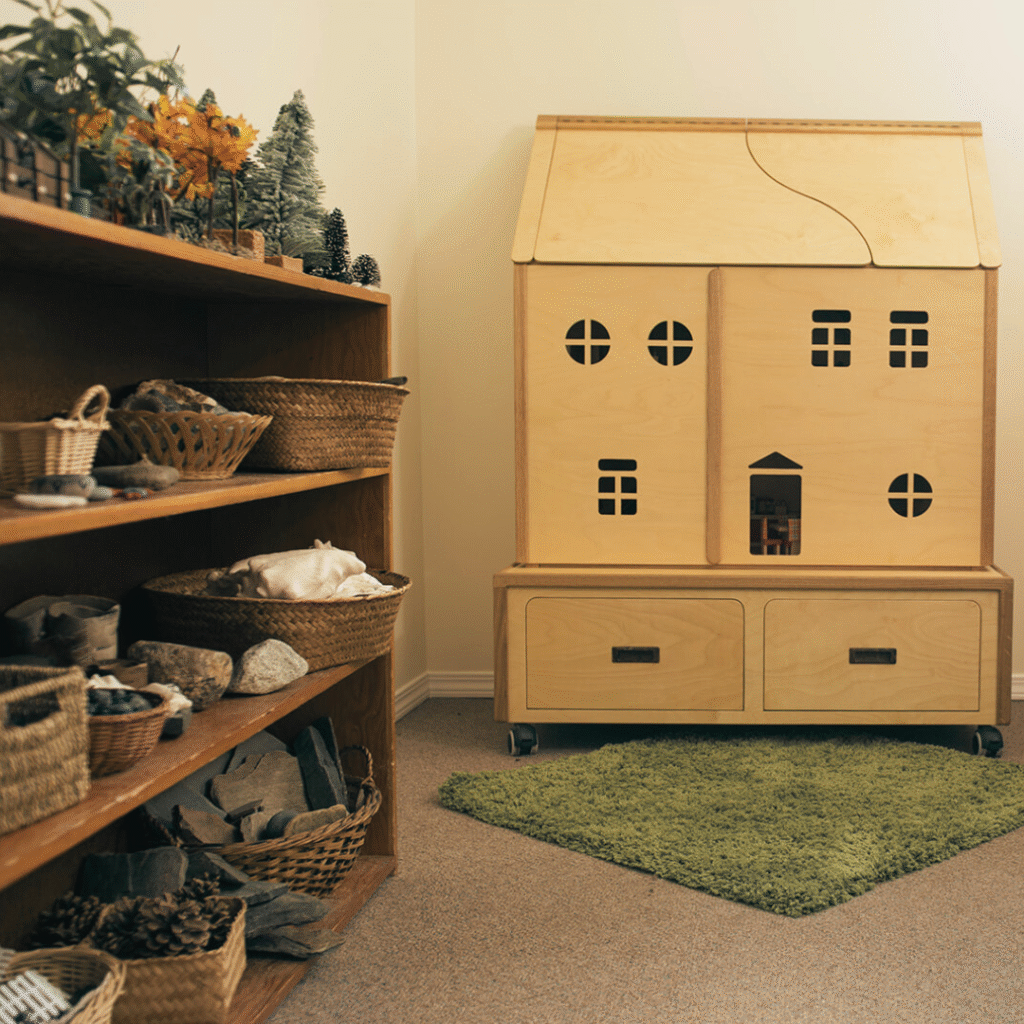
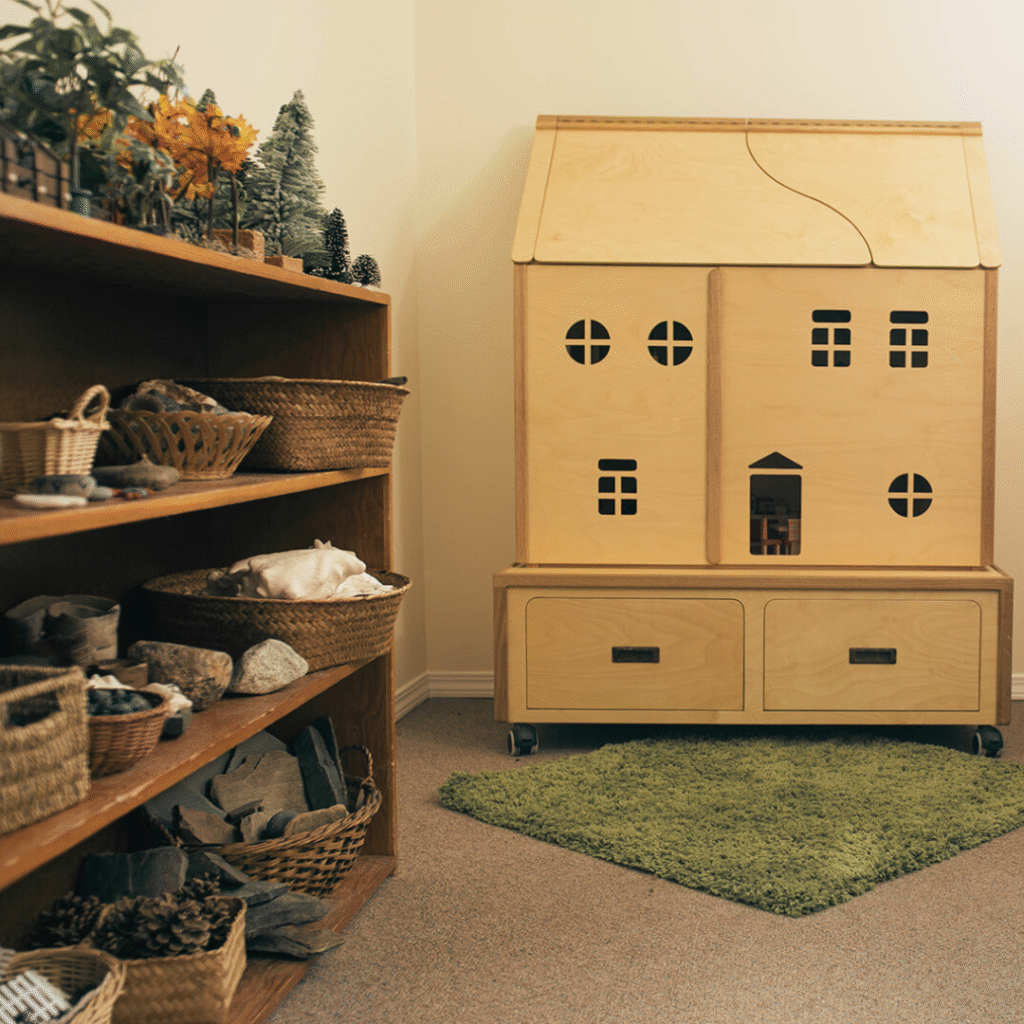
So, everything in my space has a specific home. There is an area for books, one for cards and games, the sand tray and figurines, a playhouse, a big basket of puppets. We have sports and sword fights, art, and a cozy corner for containment, which is often the spot where we share our closing story.
When we are done, everything goes back into its place.

Keeping the Symbols Covered
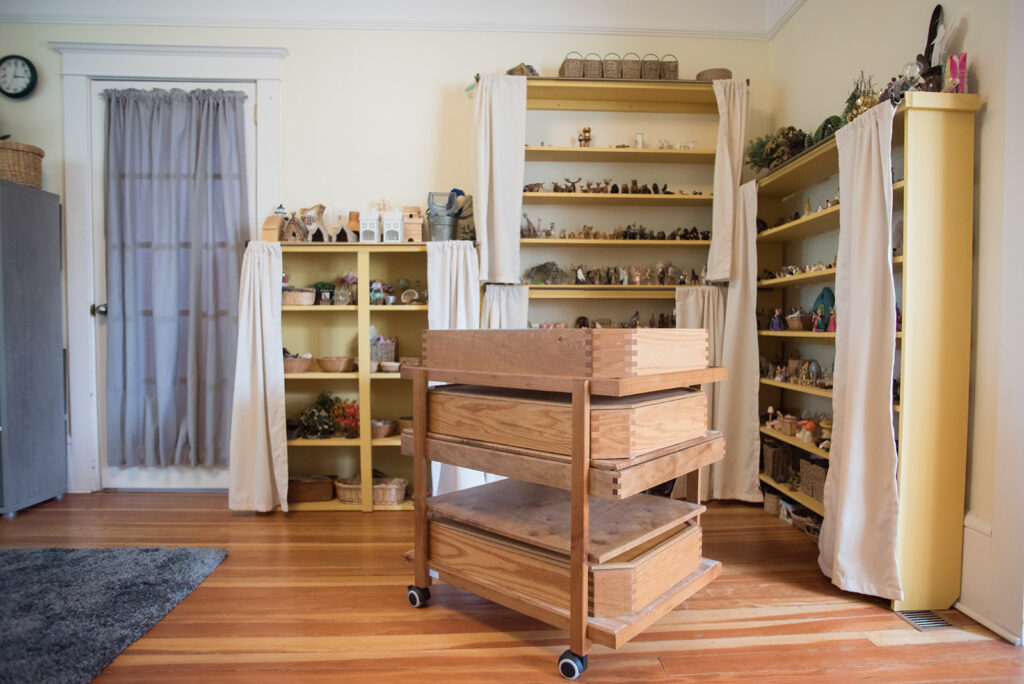
I keep my sand tray figurine shelves covered with curtains. The sight of multitudes of tiny objects can feel overwhelming. It is a lot to take in.
The right hemisphere, which communicates in symbols and metaphors, processes visual and emotional information rapidly and holistically (Schore, 2012). Excessive visual stimulation can increase arousal. By gradually revealing symbols, I am titrating stimulation in a way that respects each client’s capacity.
When the shelves are curtained, I can offer figurines gradually. If my client is new to the room or younger, I will often open just one curtain panel and offer one shelf. That is enough for them to work with and create an image. This depends on the child’s capacity, regulation, confidence, and flexibility.
I also use the curtains to keep intense figurines covered. I have a shelf of “creepy” symbols, Halloweenish and scary, that might be used in narratives expressing trauma. Some children do not want to see these figurines at all and choose to keep them covered so they can pretend they aren’t there. The curtain is invaluable in times like this.
All the Symbols Are Safe and Get Along
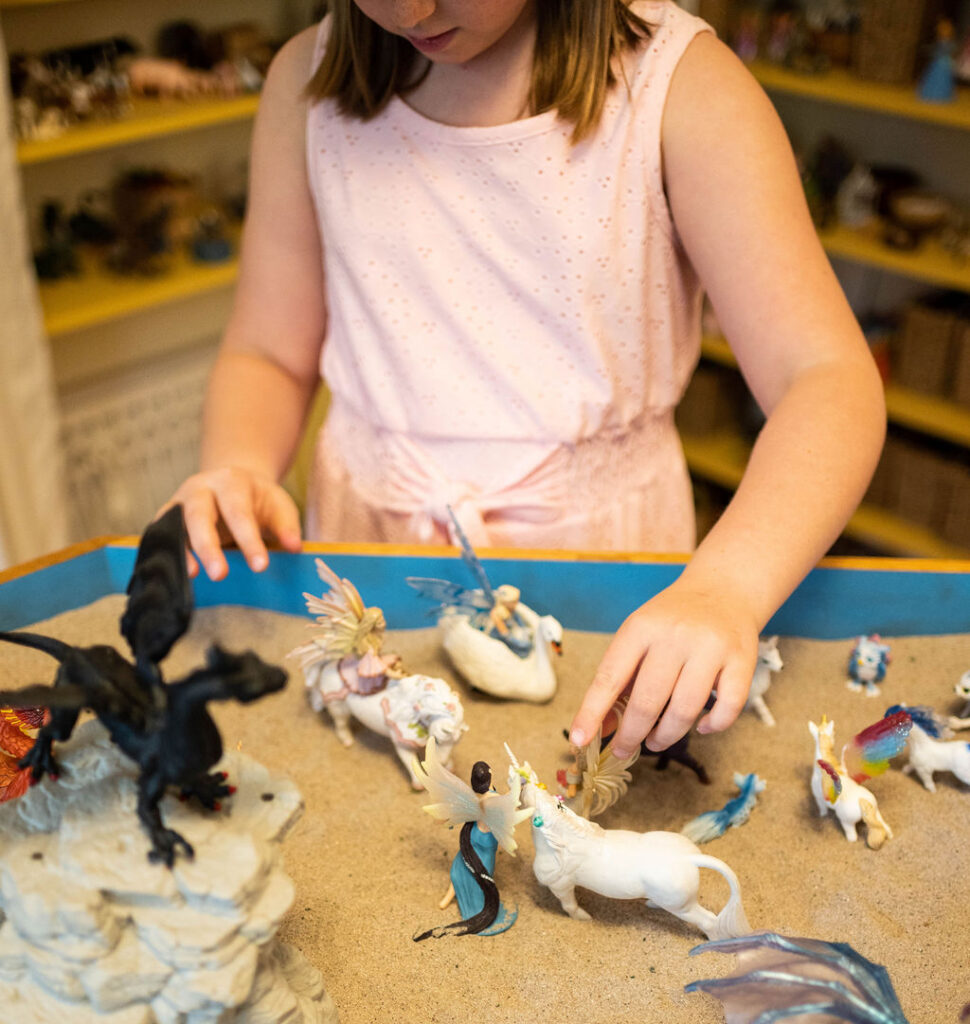
All the fairies and magical creatures share a shelf. The jungle animals are together. The sea creatures live in one basket. The pirates hang out. The forest creatures share space. This feels congruent when you look at the shelves. The deer are near the moose because those animals share an environment.
I want the figurines arranged in related clusters so that nothing feels amiss. I cannot have a dragon on the shelf beside a baby duck. Or a baby human laying in front of a wild jungle cat. Those combinations create images that communicate risk or threat before the child even begins their work. I want the shelves to communicate ease and neutrality when the child’s eyes land on them and they begin to explore what is available.
Work in the sand tray is about putting down cognitive planning and allowing the right hemisphere to lead. It includes picking up the symbols the client feels drawn to, trusting that inner knowing, and placing them in the tray. Play and symbolic expression emerge from implicit memory systems housed largely in the right hemisphere (Siegel, 2012; Schore, 2012). When shelves are organized and visually neutral, they invite projection rather than impose a narrative.
This is why I want organized, neutral, ease-filled shelves that allow figurines to stand on their own rather than in configurations that might be communicating something I do not want to be shared.
Supporting the Therapist
If, during a session, I want to offer a little boy figurine that is in jail a tiny plate of chocolate chip cookies to bring him comfort, I need to know exactly where those tiny cookies are.
My supplies are an extension of my presence. I depend on them and want to trust that they will be there when I need them. Sometimes I pick up information from the relational field that says “duck” or “blanket” or “chocolate chip cookies,” and I follow that nudge to offer something into the narrative. I need to know where each item is, so when I clean up, the doctor always goes back in the same place.
Of course, things happen outside of my control. From time to time something is misplaced or broken. When that happens, we work with what arises in response.
Predictability
The room’s organization brings safety to the child. It is predictable. It is dependable. If they need the little skeleton for the narrative, they know where he is and can trust that he will be there. The room is a ready invitation when they arrive.
Organization is a gesture. A child client attends, plays what they need to play, and then I reset the room. It is a clearing of sorts. When the next child arrives, the room looks exactly the same as every other time they have entered. Clear. Clean. Ready. Even the playhouse furniture is put back in the same way after each session.
A Counterbalance to Chaos
Many children I have sat with live lives that feel chaotic. Changes may come unexpectedly. Important people have disappeared from their lives with little explanation or understanding. They move houses. Schools change. Caregiver plans, partners, or moods may shift unpredictably. Children often have little control over these big transitions.
If that has child experienced ongoing uncertainty, incongruence, or chaos, I want the therapy room to be a place that feels the same. Dependable. Always. This builds trust. This creates safety.
If there is internal disorganization by way of trauma, thwarted development, or nervous system dysregulation, I want the external environment to be one of steadiness and predictability. Daniel Siegel (2012) describes regulation as the integration of differentiated parts into a coherent whole. Predictable environments support that integration. When a child’s inner world feels fragmented, external consistency can scaffold the nervous system and invite settling.
Not always, of course. But if it is beneficial some of the time, I am going to do my best to have it available all of the time.
The room is not neutral.
It is speaking.
It is sharing a message about what can unfold.
The possibility of healing.
References
Schore, A. N. (2012). The science of the art of psychotherapy. W. W. Norton & Company.
Siegel, D. J. (2012). The developing mind: How relationships and the brain interact to shape who we are (2nd ed.). Guilford Press.
Tronick, E. (2007). The neurobehavioral and social-emotional development of infants and children. W. W. Norton & Company.

© Relational Embodied | All rights reserved | Privacy Policy | Terms | Website Design by field digital
