

What is Relational Embodied Play Therapy
I refer to my work in the playroom as Relational Embodied Play Therapy, a name I chose to capture the scope and spirit of my practice. It does not fit neatly inside one specific model I trained in. Instead, it emerged organically over years of study, supervision, and experience.
Its roots are in three foundational play therapy approaches: Child-Centered Play Therapy, Expressive Play Therapy, and Synergetic Play Therapy. These approaches share a commitment to the therapeutic relationship, symbolic process, and deep respect for the child’s inner world. Over time, these streams braided together with my training in Somatic Attachment Psychotherapy which integrates neuroscience, interpersonal neurobiology, attachment theory, right-brain development, shame work, and body-based approaches to healing.
The theories and skills I’ve learned from these models have merged with the insights I’ve gained from thousands of sessions with hundreds of children, consultations with fellow play therapists, and my own personal healing journey. Over time, theory moved from something I understood cognitively into something I felt in my body. It became less about applying a model and more about inhabiting a way of being in the room and in relationship.
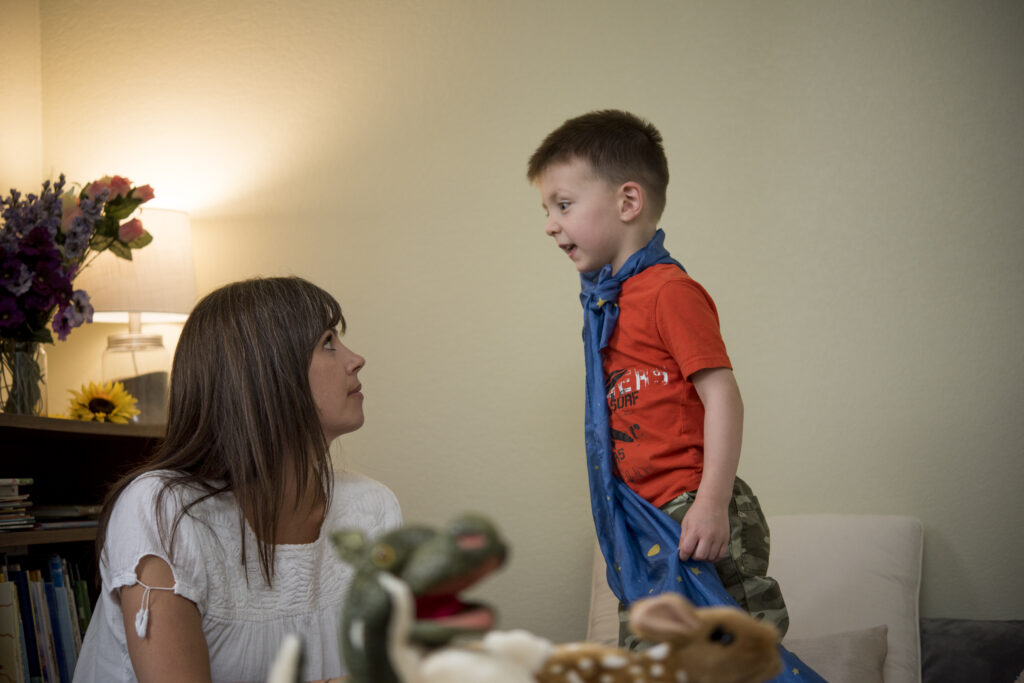
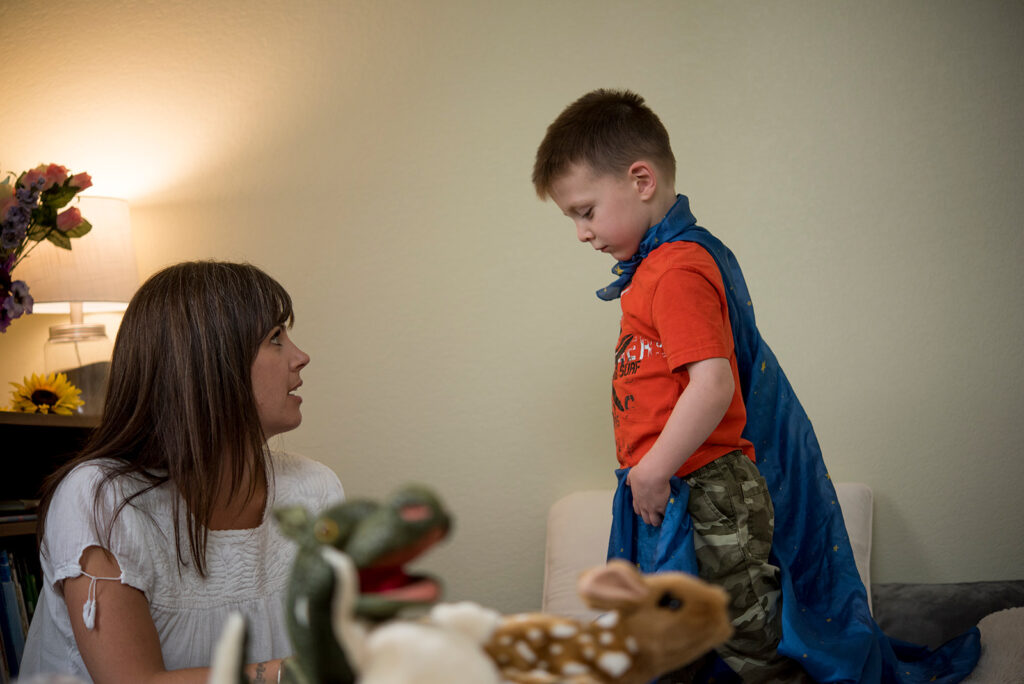
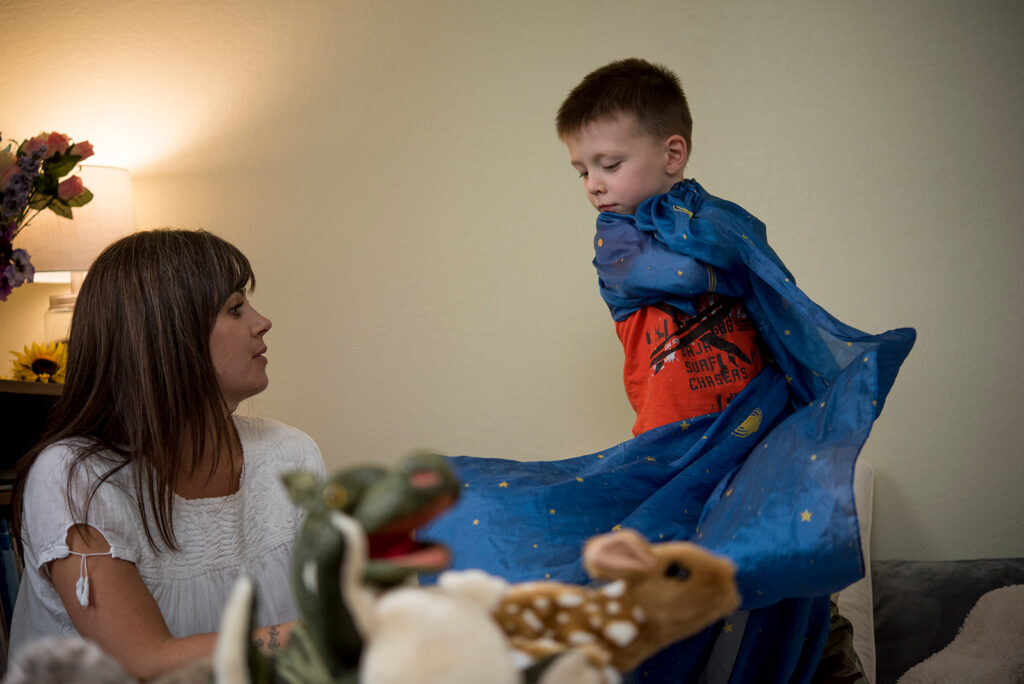
Relational Embodied Play Therapy is, at its core, a right-brained, relational, bottom-up, somatic approach to working with children.
Let’s unfold that.
Right-Brained
Neuroscience has made something beautifully clear: the right hemisphere develops first and is dominant in the early years of life. It processes emotion, facial expression, tone of voice, gesture, imagery, metaphor, and implicit memory. It is deeply involved in attachment, regulation, and the imprint of relational experiences.
In simpler terms, the left hemisphere helps to organize language, logic, and narrative. The right hemisphere is more deeply involved in emotional, embodied, and relational experience. The left hemisphere tells the story. The right hemisphere lives it.
In early development, caregiver and infant communicate primarily right-brain to right-brain through eye contact, rhythm, tone, and movement. Allan Schore describes this as a “right brain-to-right brain affective communication system” that forms the biological basis of attachment and emotional regulation.
Play therapy operates in this same domain.
When a child creates a sand tray world, plays hide and seek, repeats a rescue scene, or builds a fortress, they are not explaining their story in words. They are expressing implicit emotional memory through symbol and image. The right hemisphere is speaking.
While we certainly use language in session, the deeper work often unfolds in metaphor, and shared presence. Healing occurs when the therapist remains regulated and available enough to meet the child in that nonverbal space.
It is not questions, or interpretation, or teaching skills that changes the child. It is attuned presence.
Relational
The human nervous system develops in relationship. When relational environments are chronically dysregulated or unsafe, the child’s system adapts around survival..
Attachment research has shown that secure attachment is built through consistent attunement, repair, and co-regulation. When caregivers are regulated and responsive to a child’s emotional states, the child’s nervous system develops flexibility and resilience.
When there are chronic misattunements without repair, relational trauma, or environments marked by unpredictability, the child’s nervous system adapts in protective ways.
These adaptations are not pathology. They are actually brilliance.
The therapeutic relationship can become a new kind of relational experience. A repairitive one. Through the therapist’s consistent, embodied attunement, the child’s nervous system begins to register safety. Stephen Porges calls this neuroception, the nervous system’s unconscious detection of safety or threat. When safety is detected, defensive states soften and social engagement becomes possible which allows the repairative experience of play therapy.
Relational Embodied Play Therapy is not about fixing behavior. It is about creating a relationship within which the child’s nervous system can reorganize.
Repair happens in the micro-moments.
In the tone of voice.
In the warmth of focused attention.
In the therapist’s regulated presence.
Bottom-Up
The brain develops hierarchically, from the bottom up. The brainstem and autonomic nervous system organize first, in infancy. These systems regulate arousal, heart rate, breathing, and our fight, flight, freeze responses.
If a child’s nervous system is in a state of threat, the cortex, responsible for executive functioning and impulse control, is not readily accessible. No amount of reasoning can override a body that does not feel safe.
Daniel Siegel describes the Window of Tolerance as the zone in which a person can remain regulated enough to think, feel, and relate simultaneously. Outside of that window, we move into hyperarousal or hypoarousal.
Without a felt sense of safety, integration of past overwhelm or trauma cannot occur.
In the playroom, bottom-up work means we begin with regulation, brain stem organization, and that resonant right hemisphere connection. I track the breath, inner nervous system state, posture, movement, pacing, and tone. The first goal in my room is always co-regulation. It comes before meaningful expression, progression in development, or any shifts in behaviour.
Somatic
Somatic means “of the body.”
Developmental and relational trauma are encoded primarily in implicit memory systems housed in the right hemisphere and subcortical regions of the brain. These experiences are stored not as a sequential narrative that can be accessed cognitively, but as sensation, movement impulses, autonomic activation, and relational expectation.
Children often cannot tell us what happened in words.
But their nervous systems and their organization of symbols and metaphors show us.
Allan Schore describes how early relational experiences shape right-brain circuits responsible for affect regulation. When these circuits are organized in the context of safety and attunement, the child develops flexibility. When early environments are chaotic, frightening, or marked by chronic misattunement, the nervous system adapts around survival.
Stephen Porges’ Polyvagal Theory further explains how these adaptations become embodied autonomic patterns. The child may live in chronic sympathetic mobilization or dorsal withdrawal, depending on their history of threat and safety.
Somatic work in play therapy includes:
- Tracking shifts in breath, muscle tone, posture, and gaze
- Noticing changes in rhythm, pacing, and intensity
- Supporting co-regulation through voice, proximity, and presence
- Working symbolically to complete defensive responses in metaphor
- Gently widening the child’s Window of Tolerance through relational safety
This is experiential, right-hemispheric work.
We are not asking the child to explain.
We are helping their nervous system experience something new.
The goal is not just affective discharge.
The goal is integration.
And Then There Is the Magic
All of this is true. All of this is grounded in neuroscience. And yet, if I stop here, something is missing.
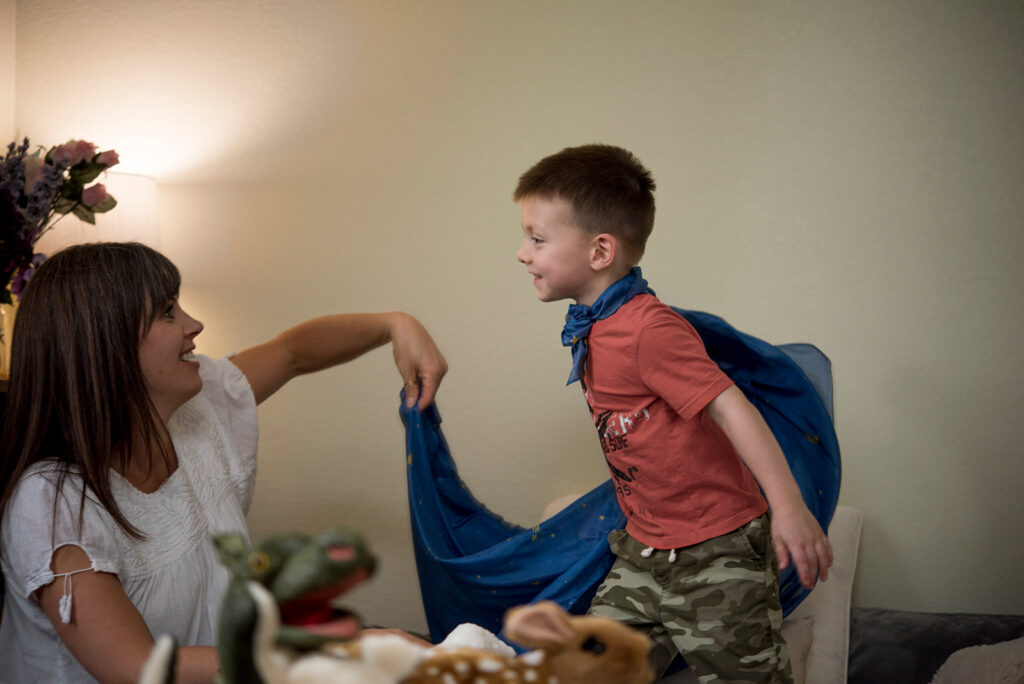
The theories do not capture that moment when a child’s face softens and brightens. When the chaotic sand tray reorganizes itself into something coherent. When a child who has only known vigilance drops their shoulders. When the symbols take on an importance, a richness, and the child focuses with such intention showing me that this play is deeply meaningful. These are the moments that feel like magic.
The right hemisphere reorganizes through new relational experience. The autonomic nervous system becomes more flexible through repeated experiences of safety. Neural pathways strengthen with repetition and integration. The sparkle that arrives in a child’s eye is what indicates they are connected to their true nature and now have the capacity to express something that has been overwhelming in the past. They are moving through it.
Relational Embodied Play Therapy is led by the child while the therapist follows. It is accepting and permissive. It is grounded in neuroscience and somatic principles. It focuses on attachment repair, nervous system regulation, and trauma integration. It is deeply respectful of the symbolic language of play and the child’s inner wisdom. And above all, it is reverent of what happens when a child reconnects to their True Self.
Neuroscience explains the mechanism.
The relationship makes it possible.
Play is the container that facilitates the healing.
Thanks for reading,
Warmly,
Rachael.

© Relational Embodied | All rights reserved | Privacy Policy | Terms | Website Design by field digital
